HISTORY OF MAYURBHANJ DISTRICT:

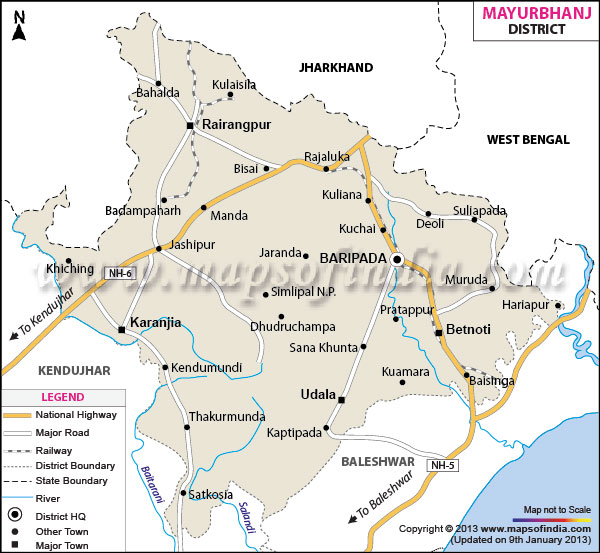
Map of Mayurbhanj
Tracing the history of Mayurbhanj leads us to the paleolithic age or stone age when man practised paleolithic human occupation .In fact Mayurbhanj was the epicentre of paleolithic human occupation from which it spread to other parts of the country. The district was the centre of activities of the Bhanja kings who had good relation with the Mayur kings of Keonjhar. So the district derives its name from the combination of titles of both the clans, The Bhanja kings ruled the district for the longest period of around 1000yrs and had their capital at Khiching . They were great promoters of art , architecture ,and culture. The Haribaldev Temple, Khichhing temple and others in the district bears testimony to it. They were also promoters of Chhau Dance which is acknowleged world wide for its unique, tribal and martial elements.
The Bhanja kings were responsible for the uplift ment of Odisha under the British rule. The Bhanja kings established the first medical college of the state in cuttack. They donated huge sums of money and land for the establishment of the higher educational institutions like Ravenshaw College . They were responsible for persuading the British for building a railway route to Odisha.
Mayurbhanj is a land-locked district as it is sorrounded by its neighbours and having no direct access to the sea spreading over a geographical area of 10418 sq.km in situated in the northen part of the state with district head quarters at Baripada. The district is sorrounded by Midnapore of West Bengal in the North-east, Singhbhum district of Jharkhand in North-west, Balasore district in the South-east and Keonjhar in the South-west. Nearly 39%(4049 sq. Km) of the total area of the district is covered by hills and forest . The district is divided into 4 subdivisions with 26 blocks and 382 Gram Panchayats and 3945 villages.
Climate : Mayurbhanj experiences sub tropical climate with extremely hot and humid temp during summer with temperature hovering around 47 deg celsius and extremely chilly winter with temp dropping to around 4 degree celsius.
Mayurbhanj occupies an unique position as it is bestowed with green vegetation ,different fauna and rich cultural heritage.The district has rich mineral base and is home to the Simlipal Biosphere. It was one of the princely state until its merger with Odisha state in 1949. It also has a rich mineral base.Mayurbhanj is rich in iron-ore, china clay,lead ore, quartzite, asbestos etc.
The iron-ore deposits of Gorumahisani, Badampahar and Suleipat, which have been exploited for a period of about half a century, deserve special mention.
Art and Culture of Mayurbhanj District
Culture is deep rooted in the lives of the people of Mayurbhanj district. The richness of the cultural heritage of the district makes Mayurbhanj one of the prominent places in the Map of Odisha.Makar Sankranti is celebrated with great pomp and show and Makar Mela is organised every year on this day.Manjurbhanj district presents us with enormous scenic beauty . In the midst of natural beauty a beautiful form of dance has evovled known as Chhau Dance .Jhumar , the traditional folk song is renowned in Mayurbhanj district Jhumar reflects the thought of popular festivities, marriages and social functions, sorrows and happiness.
THE HANDICRAFTS:The handicrafts were considered an indispensable part of the cultural heritage of the region and this sentiment continues to hold true even to this day,The attitude of people have changed towards the local handicrafts and people are increasingly aware of it. The handicrafts give creative satisfaction and satifies an urge for self-expression of the artist.The handicrafts imbibes everything of daily life how insignificant it may be with a touch of beauty and adds brightness to its existance
The traditional charm of handicrafts has got submerged partially under the impact of industrialization with high mechanization. Efforts are being made to find new market now for the handicrafts of this region, hence it is necessary to adapt certain changes particularly in the forms of improved product, design, efficient production technique.At the same time utmost care is to be taken to prevent any damage to its folk character and to preserve their beauty of form and colour perfected since centuries. Craftsman of this region are now also trained to use, in articles of modern use traditional motifs and designs without vulgarizing them.
Dhokra Craft:
Dhokra craft of Odisha
Dhokra craft is basically a brass-work(metal work). Brass is a combination of copper and bronze. Dhokra artisans practice the traditional lost wax technique to craft their imaginations.
The district forms the Northern boundary of the state of Odisha bordering West Bengal and Jharkhand. It is famous for the availability of stone especially soapstone.This stone is exported in huge quantities to all craft centres in all districts of Odisha and also to stone carving centres in all neighbouring states.Khiching is known for its quality and abundance of granite which directly accounts for a huge cluster of stone carving centres in Mayurbhanj. The crop of sabai is grown locally and accounts for huge production centres of the products made by using sabai grass for ropemaking.
Steps involved in Making Dhokra art
1. Preparing a mould out of wet earth, or with Lac, or with a combination of bee wax, sal resin or dhuna.
2. Required design is then hand created on the mould with bee-wax and Lac.
3. It is then again covered with wet earth.
4. It is bind with iron-wire. Again a layer of earth is put on the mould.
5. A hole is made in the mould.It is then heated. The heating process melts the wax or the Lac and the liquid is filled in the mould through the hole.
6. The mould is then left to cool down.
7. The artwork is then obtained by breaking the mud mould.
8. After cleaning and buffling the product is supplied to the stores
9. The motifs used are generally taken from the nature. Elephants, turtles etc are are made at large in dhokra craft. The images of various deities are also crafted by the artisans.

DHOKRA CRAFT
PLACES TO VISIT:
Mayurbhanj has the distinction of being the largest District of Odisha. Once a prominent kingdom of India,Mayurbhanj has still kept its importance alive in the history of India through a number of tourist attractions Mayurbhanj got the recognition of a district when it got amalgamated with Odisha on Jan 1st 1949. If you are planning to visit Odisha , make sure to add Mayurbhanj in your scheme of things as it has many interesting places to visit.It would not be a exaggeration to say that Mayurbhanj has got heavenly charisma
In the company of Budhabalanga River, Barehipani Waterfall and Meghasani Mountain , Mayurbhanj looks like a celestial place .Apart from its natual beauty , it is also known for its horn work stone and clay work, Tussar silk, spinning mills and jute mills Tourism in Mayurbhanj Distict offers visits to various places of interest including holy sites. The District of Mayurbhanj preserves many temples built in different styles of magnificient architecture such as Rekha, Bhadra and Gouriya. Among the temples bearing testimony to Rekha style of magnificient architecture are Kakharua Baidyanath Temple of Manitri and that of Lord Jagannath Temple at Baripada. Let's see the places of interest in this district.
 Dhokra Craft
 IMAGE OF BANGIRIPOSI GHAT
 IMAGE OF PALPALA RIVER NEAR LULUNG
KUCHAI;The excavated prehistoric site of Kuchai 8 kms north of Baripada is known for yielding neolithic possessions of man . Pottery found with neolithic implements speak of occurence of a microlithic industry of the late stone age in Mayurbhanj .Kuchai is on the way from Baripada to Simlipal. Kuchai is connected by private bus service from Balasore , Baripada , Kolkata and Tata Nagar.
 IMAGE OF KUCHAI
HARIPUR-Haripur, previously known as Hariharpur, was founded by Maharaja Harihar Bhanj in the year 1400 A.D. and remained as the capital of Bhanja Dynasty before its shifting to Baripada. Baidyanath Bhaanj, another ruler of the dynasty built here a magnificent brick temple in honour of his tutelary God Rasika-raya. Though in dilapidated condition, now the edifice has earned the distinction of being unique among the brick temples of Orissa. The vast ruins here afford
fford ample and interesting materials for antiquarian research. A little north to the courtyard of Rasikaraya temple lies the ruins of Ranihanspur (the inner apartment of queen) and to the east once stood the Durbal Hall, studded with sculptured stone colums and arches of intricate designs, the remains of which have been recently unearthed. Closeby stands the brick-built rectangular temple of Radhamohan. The temple of Jagannath also stands nearby which is built in Goudiya style of architecture during the region of Harihar Bhanj. The deities have since been shifted to the neighbouring village Pratappur and are now worshipped there.
 IMAGE OF HARIPUR
SIMLA:25 Kms. from Baripada on the left bank of the river Burhabalanga, Simla is famous for housing the shrine of Simileswar Siva. Hundreds of pilgrims visit the shrine everyday. The picturesque scenery of the place attracts group picnickers. A big fair is held on Sivaratri day which continues for a week.
DEVAGRAM:About 50 Kms.from Baripada is Devagram, otherwise called Deogan. The river Sono flows close to the village. Ruins of old temples on the bank of the river speak volumes in mute voice. A change in the course of the river might have caused a great damage to these temples. The images of Ganesh and Parvati with Shiva Lingam and the eight-armed Chamunda on a heap of stone are found here. The sculptural beauty of the Gaddess and the pedestalaround reveal excellent workmanship. Fragments of stone supposed to be parts of the ruins of Chamunda temple are still lying in the river bed. The place is ideal for picnic.
 IMAGE OF DEVAGRAM

IMAGE OF SAMIBRIKSHYA AT PODADIHA , KAPTIPADA SUBDIVISION, MAYURBHANJ
3 Kms to the south of Podadiha is seen the peak of a hillock known among the people as Samibruksha. The hillock is about 500ft. high. On the western side there are five caves, which look like five rooms from a distance. Tradition narrates that the five Pandavas hid their arms in these five caves before proceeding to the court of the king Virata. Thousands of pilgrims take their sacred bath in the nearby stream on Baruni day which falls in the month of Chaitra. Makar Sankranti which falls in mid-January is the most important festival of the place.
BHIMKUND :About 40 Kms.from Karanjia, near Booring village in Thakurmunda P.S. is the sacred pool BHIMKUND" in the river Vaitarani. The legend reveals that Bhima, the second Pandava used to take his bath in this pool when the Pandavas were passing their incognito life in Birat Nagar, said to be the present Kaptipada. Here river Vaitarani flows through a gorge in steps forming a series of picturesque rapids until it settles down in the pool called "BHIMKUND". It is encircled by precipitous stone wall. During Makar Festival in the month of January thousands of people gather here to take their holy dip. The place can also be approached from Dhenkikote (20 Kms.) on S.H. No 11 connecting Keonjhar and Panikoili. The place is ideal for picnickers.
Great epic Mahabharat Links Bhimkund with the Pandavas. Tired of Hot Scorching Sun Draupadi fainted out of thirst. Bhima, the strongest of the 5 Pandavas hit the ground with his gada , water surged out and the pool came into being.
Another Legend says it that Narad Muni performed the Gandharvan Gayan in praise of Lord Vishnu. Pleased with his devotion, Vishnu emerged from that kund and the water turned blue because of Vishnu's dark complexion.. From that time the pool came to be known as Neel Kund and Narad Kund after the sage.

IMAGE OF BHIMKUND
MANATRI:-Manatri is situated 7 miles to the south east of Badasahi and 24 miles from Baripada and is famous for its presiding deity Kakharua Baidyanath(Lord Shiva). The Local people were required to offer 3 manas of paddy to the deity.The name Manatri is said to have originated in this way.Fairs were organised in honour of the deity during Shivaratri.The temple is surrounded on 3 sides by water channels of Kundi and the Gangahar river. Tradition ascribes that a king of Somavanshi Dynasty.was attacked by Leucoderma and his whole body became depigmented with white patches and was subsequently by the grace of god. Some Oriya inscriptions of the Mayurbhanj Royal family can be ssen on the walls of the templeThere are remains of an ancient fort about half a mile to the west of the temple. Tradition has it that Maharaja Ramachandra Bhanja built this fort and lived here for some years.

Kakharua Baidyanath Temple at Manatri.
Deokund:It is beautiful temple situated near Devakunda. Devee Ambika Temple (Incarnation of Goddess Durga) is a temple which can spellbound every visitor atop the hill. It is surrouded by great waterfalls and think forest. This temple was built by the royal dynasty of Mayurbhanj in 1940. More to allure you, there are multi colored butterflies and chirping birds all around. In Devakunda. Large fishes come closer and eats food offered by the visitors because fishing is prohibited as this place is considered as the Goddess’ place. The main attraction of this place is the scenic and the beautiful natural lake that is formed due to the waterfall. The waterfall is 50ft high from the ground level. The water falls from the hills in 5 stages due to reservoirs that are built intermittently to check its flow. Thus this place is also called the panch Kunda or the five reservirs (Panch means five in Oriya language.The five kundas or the reservoirs are called Amrita Kunda, Ghrita Kunda, Haladi Kunda, Devi Kunda and Deva Kunda.
Bus route Regular private bus services to Udala (59 km). From Udala jeeps are available to reach at Devakunda (28 km from Udala). The remaining 5 km trail is through a thick forest surrounded with hills.
Train route: Nearest major railway station is at Balasore/Baleshwara. Local trains connect to Baripada from where Devakund is more nearer.
Perfect for: Picnic, Wild Photography, Trekking, Sight seeing. Accommodations available at: Balasore and Baripada Nearby spots: Similipal tiger reserve, Khiching Kichakeshwari temple, Baripada, Devakunda waterfall, Balasore.
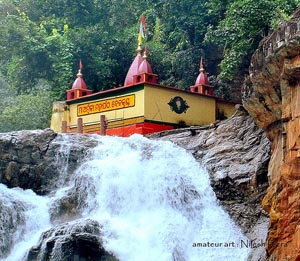 IMAGE OF DEOKUND WATERFALL
Map of Mayurbhanj
Tracing the history of Mayurbhanj leads us to the paleolithic age or stone age when man practised paleolithic human occupation .In fact Mayurbhanj was the epicentre of paleolithic human occupation from which it spread to other parts of the country. The district was the centre of activities of the Bhanja kings who had good relation with the Mayur kings of Keonjhar. So the district derives its name from the combination of titles of both the clans, The Bhanja kings ruled the district for the longest period of around 1000yrs and had their capital at Khiching . They were great promoters of art , architecture ,and culture. The Haribaldev Temple, Khichhing temple and others in the district bears testimony to it. They were also promoters of Chhau Dance which is acknowleged world wide for its unique, tribal and martial elements.
The Bhanja kings were responsible for the uplift ment of Odisha under the British rule. The Bhanja kings established the first medical college of the state in cuttack. They donated huge sums of money and land for the establishment of the higher educational institutions like Ravenshaw College . They were responsible for persuading the British for building a railway route to Odisha.
Mayurbhanj is a land-locked district as it is sorrounded by its neighbours and having no direct access to the sea spreading over a geographical area of 10418 sq.km in situated in the northen part of the state with district head quarters at Baripada. The district is sorrounded by Midnapore of West Bengal in the North-east, Singhbhum district of Jharkhand in North-west, Balasore district in the South-east and Keonjhar in the South-west. Nearly 39%(4049 sq. Km) of the total area of the district is covered by hills and forest . The district is divided into 4 subdivisions with 26 blocks and 382 Gram Panchayats and 3945 villages.
Climate : Mayurbhanj experiences sub tropical climate with extremely hot and humid temp during summer with temperature hovering around 47 deg celsius and extremely chilly winter with temp dropping to around 4 degree celsius.
Mayurbhanj occupies an unique position as it is bestowed with green vegetation ,different fauna and rich cultural heritage.The district has rich mineral base and is home to the Simlipal Biosphere. It was one of the princely state until its merger with Odisha state in 1949. It also has a rich mineral base.Mayurbhanj is rich in iron-ore, china clay,lead ore, quartzite, asbestos etc.
The iron-ore deposits of Gorumahisani, Badampahar and Suleipat, which have been exploited for a period of about half a century, deserve special mention.
Art and Culture of Mayurbhanj District
Culture is deep rooted in the lives of the people of Mayurbhanj district. The richness of the cultural heritage of the district makes Mayurbhanj one of the prominent places in the Map of Odisha.Makar Sankranti is celebrated with great pomp and show and Makar Mela is organised every year on this day.Manjurbhanj district presents us with enormous scenic beauty . In the midst of natural beauty a beautiful form of dance has evovled known as Chhau Dance .Jhumar , the traditional folk song is renowned in Mayurbhanj district Jhumar reflects the thought of popular festivities, marriages and social functions, sorrows and happiness.
THE HANDICRAFTS:The handicrafts were considered an indispensable part of the cultural heritage of the region and this sentiment continues to hold true even to this day,The attitude of people have changed towards the local handicrafts and people are increasingly aware of it. The handicrafts give creative satisfaction and satifies an urge for self-expression of the artist.The handicrafts imbibes everything of daily life how insignificant it may be with a touch of beauty and adds brightness to its existance
The traditional charm of handicrafts has got submerged partially under the impact of industrialization with high mechanization. Efforts are being made to find new market now for the handicrafts of this region, hence it is necessary to adapt certain changes particularly in the forms of improved product, design, efficient production technique.At the same time utmost care is to be taken to prevent any damage to its folk character and to preserve their beauty of form and colour perfected since centuries. Craftsman of this region are now also trained to use, in articles of modern use traditional motifs and designs without vulgarizing them.
Dhokra Craft:
Dhokra craft of Odisha
Dhokra craft is basically a brass-work(metal work). Brass is a combination of copper and bronze. Dhokra artisans practice the traditional lost wax technique to craft their imaginations.
The district forms the Northern boundary of the state of Odisha bordering West Bengal and Jharkhand. It is famous for the availability of stone especially soapstone.This stone is exported in huge quantities to all craft centres in all districts of Odisha and also to stone carving centres in all neighbouring states.Khiching is known for its quality and abundance of granite which directly accounts for a huge cluster of stone carving centres in Mayurbhanj. The crop of sabai is grown locally and accounts for huge production centres of the products made by using sabai grass for ropemaking.
Steps involved in Making Dhokra art
1. Preparing a mould out of wet earth, or with Lac, or with a combination of bee wax, sal resin or dhuna.
2. Required design is then hand created on the mould with bee-wax and Lac.
3. It is then again covered with wet earth.
4. It is bind with iron-wire. Again a layer of earth is put on the mould.
5. A hole is made in the mould.It is then heated. The heating process melts the wax or the Lac and the liquid is filled in the mould through the hole.
6. The mould is then left to cool down.
7. The artwork is then obtained by breaking the mud mould.
8. After cleaning and buffling the product is supplied to the stores
9. The motifs used are generally taken from the nature. Elephants, turtles etc are are made at large in dhokra craft. The images of various deities are also crafted by the artisans.
DHOKRA CRAFT
PLACES TO VISIT:
Mayurbhanj has the distinction of being the largest District of Odisha. Once a prominent kingdom of India,Mayurbhanj has still kept its importance alive in the history of India through a number of tourist attractions Mayurbhanj got the recognition of a district when it got amalgamated with Odisha on Jan 1st 1949. If you are planning to visit Odisha , make sure to add Mayurbhanj in your scheme of things as it has many interesting places to visit.It would not be a exaggeration to say that Mayurbhanj has got heavenly charisma
In the company of Budhabalanga River, Barehipani Waterfall and Meghasani Mountain , Mayurbhanj looks like a celestial place .Apart from its natual beauty , it is also known for its horn work stone and clay work, Tussar silk, spinning mills and jute mills Tourism in Mayurbhanj Distict offers visits to various places of interest including holy sites. The District of Mayurbhanj preserves many temples built in different styles of magnificient architecture such as Rekha, Bhadra and Gouriya. Among the temples bearing testimony to Rekha style of magnificient architecture are Kakharua Baidyanath Temple of Manitri and that of Lord Jagannath Temple at Baripada. Let's see the places of interest in this district.
KULIANA: This Place is famous for its Dhokra Craft. Many traditional art form that was designed by tribals are becoming extinct. But now - a-days Dhokra Craft has gained back its fame in the national arena for its finish and contemporariness.
BANGIRIPOSI:t is situated at a distance of 22miles from Baripada on the Baripada-Rairangpur road. It is on the eastern side of the Bidubhandar ghat that borders the Bamanghaty and Baripada subdivisions. It is the centre for collection of forest products of the Shimilipal hill ranges. It is connected with regular Bus as well as Train services from Baripada. Here, there is a beautiful temple of Goddes Dwarsuni, for which this Ghat is also known as Dwarsuni Ghat.Bangiriposi is a small town on the northern border of the Simlipal Tiger Reserve , Odisha. To reach it from the Jashipur side, one has to negotiate a ghat road called Bangiriposi Ghat . Long ago , this ghat was famous for tiger sightings , especially at night . However , human interference has taken its toll on wildlife here and there has been no confirmed tiger sighting since the past 15 yrs.
IMAGE OF BANGIRIPOSI GHAT
Lulung, Simlipal:- Located 300m above sea level in the eastern fringes of Simlipal Tiger Reserve , the small village.About 30 Kms. from Baripada is Lulung, noted for its scenic beauty. Being surrounded on three sides by hills of Similipal range, it is an ideal place for rest, relaxation and adventure. Group picnickers find the place useful for spending their leisure time. The tourists may also fine charm in purchasing stone utensil of the place.Besides exploring the surrounding jungle and Palpala River , you can visit Tribal villages . At Kaliapahar, just 3 kms away from Lulung one can view a milky white waterfall. One can have a good view of the Meghasani Peak and the Khairiburu Peak from Lulung

IMAGE OF LULUNG
IMAGE OF PALPALA RIVER NEAR LULUNGKUCHAI;The excavated prehistoric site of Kuchai 8 kms north of Baripada is known for yielding neolithic possessions of man . Pottery found with neolithic implements speak of occurence of a microlithic industry of the late stone age in Mayurbhanj .Kuchai is on the way from Baripada to Simlipal. Kuchai is connected by private bus service from Balasore , Baripada , Kolkata and Tata Nagar.
IMAGE OF KUCHAIHARIPUR-Haripur, previously known as Hariharpur, was founded by Maharaja Harihar Bhanj in the year 1400 A.D. and remained as the capital of Bhanja Dynasty before its shifting to Baripada. Baidyanath Bhaanj, another ruler of the dynasty built here a magnificent brick temple in honour of his tutelary God Rasika-raya. Though in dilapidated condition, now the edifice has earned the distinction of being unique among the brick temples of Orissa. The vast ruins here afford
fford ample and interesting materials for antiquarian research. A little north to the courtyard of Rasikaraya temple lies the ruins of Ranihanspur (the inner apartment of queen) and to the east once stood the Durbal Hall, studded with sculptured stone colums and arches of intricate designs, the remains of which have been recently unearthed. Closeby stands the brick-built rectangular temple of Radhamohan. The temple of Jagannath also stands nearby which is built in Goudiya style of architecture during the region of Harihar Bhanj. The deities have since been shifted to the neighbouring village Pratappur and are now worshipped there.
IMAGE OF HARIPURSIMLA:25 Kms. from Baripada on the left bank of the river Burhabalanga, Simla is famous for housing the shrine of Simileswar Siva. Hundreds of pilgrims visit the shrine everyday. The picturesque scenery of the place attracts group picnickers. A big fair is held on Sivaratri day which continues for a week.
DEVAGRAM:About 50 Kms.from Baripada is Devagram, otherwise called Deogan. The river Sono flows close to the village. Ruins of old temples on the bank of the river speak volumes in mute voice. A change in the course of the river might have caused a great damage to these temples. The images of Ganesh and Parvati with Shiva Lingam and the eight-armed Chamunda on a heap of stone are found here. The sculptural beauty of the Gaddess and the pedestalaround reveal excellent workmanship. Fragments of stone supposed to be parts of the ruins of Chamunda temple are still lying in the river bed. The place is ideal for picnic.
IMAGE OF DEVAGRAMIMAGE OF SAMIBRIKSHYA AT PODADIHA , KAPTIPADA SUBDIVISION, MAYURBHANJ
3 Kms to the south of Podadiha is seen the peak of a hillock known among the people as Samibruksha. The hillock is about 500ft. high. On the western side there are five caves, which look like five rooms from a distance. Tradition narrates that the five Pandavas hid their arms in these five caves before proceeding to the court of the king Virata. Thousands of pilgrims take their sacred bath in the nearby stream on Baruni day which falls in the month of Chaitra. Makar Sankranti which falls in mid-January is the most important festival of the place.
BHIMKUND :About 40 Kms.from Karanjia, near Booring village in Thakurmunda P.S. is the sacred pool BHIMKUND" in the river Vaitarani. The legend reveals that Bhima, the second Pandava used to take his bath in this pool when the Pandavas were passing their incognito life in Birat Nagar, said to be the present Kaptipada. Here river Vaitarani flows through a gorge in steps forming a series of picturesque rapids until it settles down in the pool called "BHIMKUND". It is encircled by precipitous stone wall. During Makar Festival in the month of January thousands of people gather here to take their holy dip. The place can also be approached from Dhenkikote (20 Kms.) on S.H. No 11 connecting Keonjhar and Panikoili. The place is ideal for picnickers.
Great epic Mahabharat Links Bhimkund with the Pandavas. Tired of Hot Scorching Sun Draupadi fainted out of thirst. Bhima, the strongest of the 5 Pandavas hit the ground with his gada , water surged out and the pool came into being.
Another Legend says it that Narad Muni performed the Gandharvan Gayan in praise of Lord Vishnu. Pleased with his devotion, Vishnu emerged from that kund and the water turned blue because of Vishnu's dark complexion.. From that time the pool came to be known as Neel Kund and Narad Kund after the sage.
IMAGE OF BHIMKUND
MANATRI:-Manatri is situated 7 miles to the south east of Badasahi and 24 miles from Baripada and is famous for its presiding deity Kakharua Baidyanath(Lord Shiva). The Local people were required to offer 3 manas of paddy to the deity.The name Manatri is said to have originated in this way.Fairs were organised in honour of the deity during Shivaratri.The temple is surrounded on 3 sides by water channels of Kundi and the Gangahar river. Tradition ascribes that a king of Somavanshi Dynasty.was attacked by Leucoderma and his whole body became depigmented with white patches and was subsequently by the grace of god. Some Oriya inscriptions of the Mayurbhanj Royal family can be ssen on the walls of the templeThere are remains of an ancient fort about half a mile to the west of the temple. Tradition has it that Maharaja Ramachandra Bhanja built this fort and lived here for some years.
Kakharua Baidyanath Temple at Manatri.
Deokund:It is beautiful temple situated near Devakunda. Devee Ambika Temple (Incarnation of Goddess Durga) is a temple which can spellbound every visitor atop the hill. It is surrouded by great waterfalls and think forest. This temple was built by the royal dynasty of Mayurbhanj in 1940. More to allure you, there are multi colored butterflies and chirping birds all around. In Devakunda. Large fishes come closer and eats food offered by the visitors because fishing is prohibited as this place is considered as the Goddess’ place. The main attraction of this place is the scenic and the beautiful natural lake that is formed due to the waterfall. The waterfall is 50ft high from the ground level. The water falls from the hills in 5 stages due to reservoirs that are built intermittently to check its flow. Thus this place is also called the panch Kunda or the five reservirs (Panch means five in Oriya language.The five kundas or the reservoirs are called Amrita Kunda, Ghrita Kunda, Haladi Kunda, Devi Kunda and Deva Kunda.
Bus route Regular private bus services to Udala (59 km). From Udala jeeps are available to reach at Devakunda (28 km from Udala). The remaining 5 km trail is through a thick forest surrounded with hills.
Train route: Nearest major railway station is at Balasore/Baleshwara. Local trains connect to Baripada from where Devakund is more nearer.
Perfect for: Picnic, Wild Photography, Trekking, Sight seeing. Accommodations available at: Balasore and Baripada Nearby spots: Similipal tiger reserve, Khiching Kichakeshwari temple, Baripada, Devakunda waterfall, Balasore.
IMAGE OF DEOKUND WATERFALL
IMAGE OF DEOKUND WATERFALL
BARIPADA: Baripada is the district headquarters of Mayurbhanj district in the state of Odisha.This region is home to Simlipal, one of the most important wildlife parks of India. Rathyatra is one of the main attraction of Baripada. It is the second most popular Rath Yatra after Puri.In Baripada Rath Yatra only women are allowed to pull the chariot of Maa Subhadra. Chhau Dance, a martial dance form of Mayurbhanj originated at Baripada.The 5th battalion of Odisha State Armed Police is situated at Rangamatia.
BARIPADA PALACE:Mayurbhanj palace was the royal Palace of the Maharajas of Mayurbhanj, which was a princely state during the British rule. It is a heritage architectural monument and landmark of Baripada town , which was the capital of Mayurbhanj state.The extravagently decorated palace depicts the rarest enginneering skill and architectural excellence of a bygone era. The construction of the first phase of the palace began on the orders of Maharani Sumitra Devi Bhanjadeo in 1804. The palace gained its aura of majesty with intricate designs during the rule of Maharaja Krushna Chandra Bhanjadeo, Maharaja Sriram Chandra Bhanjadeo, and Maharaja Pratap Chandra Bhanjdeo.It is a brick built double storey structure in western style with mixture of Greek and Victorian style structure, has 126 rooms, built of Lime mortar. The front of the Palace resembles Buckingham Palace
The walls of the royal bathing ghat was studded with mirrors reflecting the sun rays on the water sprouting from a fountain illumnating the ghat . This wonderful specimen of enginnering was shortlived as the pool was converted into a libraryof Maharaja Purna Chandra College when the government took over the building.
The Mayurbhanj palace also once housed the temple of Godess Kichakeshwari, the kuladevi of the Bhanja Dynasty.

IMAGE OF THE BARIPADA PALACE
SIMLIPAL NATIONAL PARK-Simlipal national park is a national park and a tiger reserve situated in Mayurbhanj District in the Indian state of Odisha.It is a part of the Simlipal-Kuldiha-Hadgarh Elephant Reserve, which includes 3 protected areas such as Simlipal Tiger Reserve, Kuldiha Wildlife Sanctuary and Hadgarh Wildlife Sanctuary . Simlipal derives its name from Semul or Red Silk Cotton trees that grow in abundance in that locality.

IMAGE OF SIMLIPAL NATIONAL PARK
CAUTION:Simlipal comes under a high cerebral malaria-prone zone.In celebral malaria the sequestrated red blood cells can breach the blood brain barrier leading to coma .Cerebral malaria, if not detected, causes death within 15 days of infection.Initial symptoms are often mistaken as those of acute jaundice. Therefore it is extremely important for tourists to be aware of the threats of celebral malaria before visiting Simlipal.
KHICHING:Khiching is an ancient village in Mayurbhanj district of Odisha. It is the abode of Maa Kichakeshwari Devi. Here a temple was built in honour of Maa Kichakeswari, the kuladevi of Bhanja Dynasty and the state deity of Princely state of Mayurbhanj.out of black stone. The temple was constructed in the year 920/ 925. The temple suffered in the hands of the vandals . Maharaja Pratap Chandra Bhanjadeo reconstructed the temple in 1934. Height of the temple is 100 ft and it occupies an area of 1764 sq .ft. The temple remains closed between 12 noon and 3pm.There is also a museum constructed by Maharaja Purna Chandra Deo in the year 1922 which boasts of highly important historical specimens of sculpture and art.The temple is made up of black chlorite which faces the east and consists of Rekha Vimana and stands over a high platform of 1.20 meters.The interior is single roomed where the goddess is present and worshipped. The shrine contains a large ten-armed fearsome skeletal image of Chamunda-kali with striking veins, ribs and sunken belly, wearing a garland of skull and seated over a dead body. The exterior of the temple is decorated with magnificient sculptures of nayakas, nagas-nagins , Ganesha , Kirtimukha and Khakaramundi and other god and goddess. The pillars sculpted with nagins are unique heritage of this temple.
ARCHEOLOGY AND KHICHING
Though the town of khiching in Mayurbhanj district is well known among tourist as the abode of Maa Kichakeshwari.(Goddess Chamunda or Kali).However, many do not know that different religious sects resided in this region centuries ago.The antiquities unearthed from the sites around the Kichakeshwari Temple and other places adjoining the area show that in the past the local residents might have professed Buddhism, Jainism and Brahmanism.
The Khiching Museum is yet another attraction of Khiching as it is the 2nd oldest museum in the state of Odisha. As the erstwhile rulers were fond of archeology and documenting the rich historical tradition of the region, the Khiching Museum was established under the Mayurbhanj State Archeology in 1922.after the establishment of the Baripada Museum in 1903.
These two museums, in fact, laid the foundation stone for the archaeological documentation for the first time in Odisha, which was then under the British rule.
Viraat Garh within 15 km of the Khiching Temple is yet to be excavated properly by the state Archeology.Khiching is also famous for the stone carving works. “Many travellers even today come here to buy the beautiful local stone products from a village called Keshna.The small town is situated within 25km from the sub-divisional headquarters town of Karanjia of Panchpir and is well connected through roads. The NH-6 is also within 10km from Khiching.

BARIPADA: Baripada is the district headquarters of Mayurbhanj district in the state of Odisha.This region is home to Simlipal, one of the most important wildlife parks of India. Rathyatra is one of the main attraction of Baripada. It is the second most popular Rath Yatra after Puri.In Baripada Rath Yatra only women are allowed to pull the chariot of Maa Subhadra. Chhau Dance, a martial dance form of Mayurbhanj originated at Baripada.The 5th battalion of Odisha State Armed Police is situated at Rangamatia.
BARIPADA PALACE:Mayurbhanj palace was the royal Palace of the Maharajas of Mayurbhanj, which was a princely state during the British rule. It is a heritage architectural monument and landmark of Baripada town , which was the capital of Mayurbhanj state.The extravagently decorated palace depicts the rarest enginneering skill and architectural excellence of a bygone era. The construction of the first phase of the palace began on the orders of Maharani Sumitra Devi Bhanjadeo in 1804. The palace gained its aura of majesty with intricate designs during the rule of Maharaja Krushna Chandra Bhanjadeo, Maharaja Sriram Chandra Bhanjadeo, and Maharaja Pratap Chandra Bhanjdeo.It is a brick built double storey structure in western style with mixture of Greek and Victorian style structure, has 126 rooms, built of Lime mortar. The front of the Palace resembles Buckingham Palace
The walls of the royal bathing ghat was studded with mirrors reflecting the sun rays on the water sprouting from a fountain illumnating the ghat . This wonderful specimen of enginnering was shortlived as the pool was converted into a libraryof Maharaja Purna Chandra College when the government took over the building.
The Mayurbhanj palace also once housed the temple of Godess Kichakeshwari, the kuladevi of the Bhanja Dynasty.
IMAGE OF THE BARIPADA PALACE
SIMLIPAL NATIONAL PARK-Simlipal national park is a national park and a tiger reserve situated in Mayurbhanj District in the Indian state of Odisha.It is a part of the Simlipal-Kuldiha-Hadgarh Elephant Reserve, which includes 3 protected areas such as Simlipal Tiger Reserve, Kuldiha Wildlife Sanctuary and Hadgarh Wildlife Sanctuary . Simlipal derives its name from Semul or Red Silk Cotton trees that grow in abundance in that locality.
Important tourist point within STR like waterfall at ‘Barehipani’ & ‘Joronda’, ‘Gurgudia’ Orchidarium, ‘Chahala’ meadow can be covered during a day-long tour to STR. If you start the tour at around 7 o’clock in the morning from the Jashipur entry gate you will be able to cover ‘Gurguria orchidarium’, then ‘Uski’ waterfall, ‘Joronda’ waterfall, ‘Barehipani’ waterfall, have lunch at Barehipani, before visiting the final tourist point at Chahala. You can be back to Jashipur by 6 o’clock in the evening same day. Vegetarian meal by local women SHG groups are provided at Barehipani at a cost of Rs.80/- per meal. You need to collect food coupon from the entry gates, so as to avail this facility. The local SHG group is also providing snacks at Gurgudia tourist complex.
If you can afford to spend more time for Similipal then the following areas located at the periphery of the Tiger Reserve are recommended. You can spend one full day visiting ‘Sitakund’ waterfall in the periphery near Pithabata entry gate about 20kms from Baripada and ‘Devkund’ waterfall along the Baripada and Udala road about 50 kms away from Baripada. If you are staying at Jashipur then another full day can be spent for visiting ‘Bhimkunda’ waterfall along the border of Keonjhar District and the Khiching temple about 30 kms from Jashipur. Local guides are available for trekking from Jamuani complex to nearby waterfall, which takes about 45 min. to reach one way. Similarly, another trekking route from Jamuani complex to Brundaban check gate is available which takes about 4 hrs one way.
WHERE Can you stay:
You can stay in 2 areas within Simlipal Tiger Reserve
Gurguria
Jamuani
Gurguria is within buffer area and takes about 1hr journey by road from Jashipur. The Jamuani complex is adjoining to STR and takes about 45min. journey from Jashipur. Facilities available at Jamuani complex are one Forest Rest Shed of 2 rooms with attached toilet. There are 4 other tented accommodations apart from 2 other 3 bedded cottages available. The complex has been provided with solar light system. Tourist can avail the restaurant facilities being managed thereat by local EDC members.The Simlipal national park was the hunting ground for the Mayurbhanj royalty.
This place is best known for its flora and fauna,96 species of orchids have been identified .Britishers have planted Eucalyptus in the year 1900 that are amazing to see. Sal forests and dry and decidious hill forest are major attraction of this place.This place is home to 242 species of birds, 30 reptiles, 42 species are there, 231 species of birds. The peaks of Meghasani and Khairiburu welcome guests from their emerald heights.
Barehipani Waterfall-
| |||||||||||||||||

IMAGE OF SIMLIPAL NATIONAL PARK
CAUTION:Simlipal comes under a high cerebral malaria-prone zone.In celebral malaria the sequestrated red blood cells can breach the blood brain barrier leading to coma .Cerebral malaria, if not detected, causes death within 15 days of infection.Initial symptoms are often mistaken as those of acute jaundice. Therefore it is extremely important for tourists to be aware of the threats of celebral malaria before visiting Simlipal.
KHICHING:Khiching is an ancient village in Mayurbhanj district of Odisha. It is the abode of Maa Kichakeshwari Devi. Here a temple was built in honour of Maa Kichakeswari, the kuladevi of Bhanja Dynasty and the state deity of Princely state of Mayurbhanj.out of black stone. The temple was constructed in the year 920/ 925. The temple suffered in the hands of the vandals . Maharaja Pratap Chandra Bhanjadeo reconstructed the temple in 1934. Height of the temple is 100 ft and it occupies an area of 1764 sq .ft. The temple remains closed between 12 noon and 3pm.There is also a museum constructed by Maharaja Purna Chandra Deo in the year 1922 which boasts of highly important historical specimens of sculpture and art.The temple is made up of black chlorite which faces the east and consists of Rekha Vimana and stands over a high platform of 1.20 meters.The interior is single roomed where the goddess is present and worshipped. The shrine contains a large ten-armed fearsome skeletal image of Chamunda-kali with striking veins, ribs and sunken belly, wearing a garland of skull and seated over a dead body. The exterior of the temple is decorated with magnificient sculptures of nayakas, nagas-nagins , Ganesha , Kirtimukha and Khakaramundi and other god and goddess. The pillars sculpted with nagins are unique heritage of this temple.
ARCHEOLOGY AND KHICHING
Though the town of khiching in Mayurbhanj district is well known among tourist as the abode of Maa Kichakeshwari.(Goddess Chamunda or Kali).However, many do not know that different religious sects resided in this region centuries ago.The antiquities unearthed from the sites around the Kichakeshwari Temple and other places adjoining the area show that in the past the local residents might have professed Buddhism, Jainism and Brahmanism.
The Khiching Museum is yet another attraction of Khiching as it is the 2nd oldest museum in the state of Odisha. As the erstwhile rulers were fond of archeology and documenting the rich historical tradition of the region, the Khiching Museum was established under the Mayurbhanj State Archeology in 1922.after the establishment of the Baripada Museum in 1903.
These two museums, in fact, laid the foundation stone for the archaeological documentation for the first time in Odisha, which was then under the British rule.
Viraat Garh within 15 km of the Khiching Temple is yet to be excavated properly by the state Archeology.Khiching is also famous for the stone carving works. “Many travellers even today come here to buy the beautiful local stone products from a village called Keshna.The small town is situated within 25km from the sub-divisional headquarters town of Karanjia of Panchpir and is well connected through roads. The NH-6 is also within 10km from Khiching.
IMAGE OF KHICHING TEMPLE

No comments:
Post a Comment