The state of Orissa has a rich cultural and artistic heritage . Due to the patronage shown to it during the reign of various rulers it has evolved to a great extent and diversified in the forms of traditional handicrafts , painting , carving, dance and music.
Dance: Odissi Dance is the most prominent form of classical dance originating in the state of Odisha .
It is also the oldest form of dance to have survived till now. It was supressed during the British Raj but was re structured after India's independence. It can be distinguished from the other forms of classical dance on the basis of emphasis it lays on Tribhangi (the independent movement of the head ,and chest and pelvis). The dance is characterised by various bhangas depicting various postures involving the foot The common Bhangas are bhangas , atibhanga , tribhanga, Abanga .
The central deity of Simachalam Temple, an lion-man incarnation of Lord Vishnu is an instance of Tribhanga posture
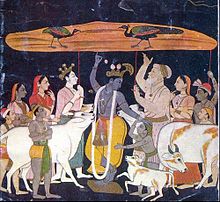
Tribhanga posture is a posture involving the bending of the neck, knee and waist. For instance Lord Krishna upholding Govardhan Mountain in Tribhanga posture.
Details of Salabhanjika of Belur in Tribhangi position.

A number of Musical instruments accompanies odissi dance such as madal,bansuri, manjira, sitar and Tanpura.
The Odissi Tradition existed in 3 other schools: Maharis, Nartakis and Gotipua
Maharis: Maharis are Devadasis or Temple Girls deriving their name from Maha (Great ) and Nari particularly at the Jagannath Temple at Puri performing Nritya and abhinaya on the lyrics of Gita Gobinda..Maharis are of 2 types: Bhitari gauni Maharis and Bahari gauni Maharis.
Bhitari Gauni Maharis were allowed in the inner Temple whereas Bahari gauni Maharis were excluded from the sacred sanctorum
Gotipua: Gotipua form of dance emerged by the 6th Century .One of the reasons for the emergence of Gotipuas is that Vaishnavas did not approve of dancing of women.Young men dressed as girls were the Gotipuas and taught the dance by Maharis .During this period various lyrics in Oriya were composed by the Vaishnava poets dedicated to Lord Krishna and Radha . Gotipuas danced to these compositions.They were allowed to dance out of the premises of the Temple.
Nartakis: The Nartaki dance used to take place in the royal courts and was very popular before the advent of the British Rule at a time when Devadasi system was criticized due to misuse of Devadasis.
Chhau Dance: Chhau dance comes under the genre of Indian Tribal Martial Dance popular in the states of Orissa, Jharkhand and West Bengal. There are also subgenres of this dance,based on the place of origin and development :Purulia Chhau , Saraikella Chhau and Mayurbhanj Chhau . Chhau Dance derives its name from Sanskrit word Chhau meaning Shadow and Mask. But according to Sita kant Mahapatra it is derivedfrom Chhauni meaning Millitary Camp.
Features of the Chhau:The Chhau Dance is performed especially during the Spring festivals or Chaitra Festival which lasts for 13 days and in which the whole community participates. The Chhau dance is an amalgamation of both dance and martial practices using mock combat techniques , stylized gaits of birds and animals and movements based on the chores of village housewives The dance is performed by male dancers from families of traditional artists or from local communities and is performed at night in an open space, called akhada , to traditional and folk music, played on the reed pipes mohuri and shenhai. A variety of drums accompany the music ensemble including the dhol (a cylindrical drum), dhumsa (a large kettle drum) and kharka or chad-chadi. The themes for these dances include local legends, folklore and episodes from the Ramayana and Mahabharat and other abstract themes.
The Chhau dance is mainly performed by the Mundas, Mahato, Kalindi, Pattanaik, Samal, Daroga, Mohanty, Acharya, Bhol, Kar, Dubey, and Sahoo communities. The musical accompaniment for the dance is provided by people of communities known as Mukhis, Kalindis, Ghadheis and Dhadas who are also involved in the making of the instruments
The most prominent difference between the 3 genres of Chhau is regarding the use of masks.While the Saraikella and Purulia chhau use masks. Mayurbhanj Chhau uses none. The Mayurbhanj Chhau dance enjoyed royal patronage under Maharaja Shriram Chandra Bhanjadeo and Pratap Chandra Bhanjadeo of Baripada.
Measures to safe guard Chhau;The Govt of Odisha established the Mayurbhanj Chhau Nitya Pratisthan at Baripada in 1962 since the abolition of princely states made it difficult for local communities to continue the tradition. The Sangeet Natak Academy gives grants to Cultural institutions for the promotion of Chhau Dance.
CHHAU DANCE OF MAYUR BHANJ

Paika Nrutya: The Paika Nritya of Odisha is a form of battle Dance.The dance form practised among the paikas , the main warrior class of the old Oriya army showcases fiery battle spirit of the army.The word owes its origin from the Sanskrit word "Padatika"meaning the "Infantry"They dance a fiery battle dance while the drums play on and is regarded as a clarion call urging the dancers to get ready for a fierce battle ahead.This Paika Nritya is practised among the warrior or paika communities of Khurda and Puri at a Paika Akhada . Paika Akhada is a place where they practice physical exercise along with other activities like fighting with swords and Shields. It is practised among the Paika with great enthusiasm during Dussehra.
PAIKA NRUTYA OF KHURDA AND PURI


